March 2, 2016

Basics Of Italian Food Culture

Italian Artistic Cappuccino
No one will argue with the fact that food in Italy is out of this world. Well-made, rich in taste and texture and guaranteed to leave you hungry for more, there’s nothing quite like Italian cuisine. There’s a detailed, fascinating tapestry of history, customs and trends for what you’re eating – so with that in mind, let’s explore some of the key aspects..
LIGHT BREAKFASTS
Italians by and large, breakfast in Italy is a refreshingly modest affair in comparison. The typical Italian breakfast runs along the lines of a coffee (such as caffe latte or cappuccino – although the latter is a no no after 10 am), bread rolls, cookies and pastries. Other popular choices include fruit salad, yoghurt and muesli. Breakfast tends to be on the lighter side is because Italians are saving their appetites for the main meal of the day: lunch!

VEGETABLES FOR ALL SEASONS

Talking of fresh vegetables, there is a very definite pattern as to what you can eat throughout the year.

It’s a seasonal thing, with certain vegetables being produced in prolific quantities for a specific spell and then making way for a different selection. So, with Summer coming up, for example, particular favorites include aubergines, beans, beetroot, cucumbers, courgettes, peas, radishes and tomatoes.

When Winter comes again, the colder months bring along the likes of artichokes, broccoli, brussel sprouts, cabbages, cauliflowers, fennel, spinach and turnips.

However, there are still a select few vegetables to be grown throughout all of the year – and these include chicory, lettuce and carrots.

CELEBRATE HOLIDAYS AT THE TABLE

One of the great things about Italian food is its unique feel for the holiday seasons. Christmas and Easter alone bring a selection of specially made foods, both sweet and savory that will tempt the taste-buds.

A number of traditional goodies are laid on at Easter including Minestra di Pasqua. This is a soup that contains ingredients such as beef, pork, kale and herbs, and is a dish that is especially popular in Naples. Agnello – or lamb.

Desserts at Easter include Gubana Easter Bread (which is plated up in northern Friuli) and Ciambelone, which hovers somewhere between bread and cake. Its very distinctive flavour comes from the zest of lemons, and is a delicious dessert to enjoy during this season.

Christmas of course, brings a Santa’s sack full of festive favorites including perennial favorite, Panettone. Shaped like a dome, this sweet bread fruit loaf includes a healthy mix of ingredients such as raisins, candied orange and lemon zest. Another popular fruit cake is Panforte which also features nuts, honey, spices and almonds – not to mention a sneaky topping of icing sugar.

Common savory dishes include mixed meats such as beef, veal and Cotechino sausage (served with ingredients like onions, celery and carrots). Popular festive fish meals include calamari (squid), baccala (salted cod) and swordfish. Pasta dishes are also widely eaten at Christmas including Anolini, a stuffed pasta served in broth, vermicelli with clams or mussels (a speciality in Naples) and of course, all types of lasagne!

 GELATO

Gelato vs Ice Cream: It’s the age-old battle.

Before you know it, Summer will be here, and it’ll be that time of year when you can enjoy the delights of Gelato and Ice Cream. But Gelato (which means “frozen” or to “freeze”) does make for a healthier alternative, containing less sugar. Another difference between Gelato and Ice Cream is that the former involves a slower churning process.

As if that’s not enough with differences, there is also the difference between Gelato and Sorbetto. It’s a north-south divide as Gelato hails from Northern Italy while Sorbetto comes from the South. And of course, one key ingredient substitute difference between the two to add to the mix of fruit and sugar is that of milk for Gelato and water for Sorbetto. But whatever you choose, both make for very tasty Summer treats!


SIMPLE SUPPERS

Fine dining. A common trend in today’s culinary world. But while the fancy arrangements, carefully selected ingredients and rather eye-popping prices may be for some tastes, let’s not forget that simple is sometimes the best. It’s like at the end of the month when the money’s run out and you’re looking to create what you can from what’s left in the larder. But many times, this can result in a truly delicious culinary creation: it’s food serendipity at it’s finest.

This has proved to be the case with a good number of dishes that have started out from more humble beginnings. Peasant dishes have stood the test of time and are still popular today. Ribollita is a soup that began with peasant origins – it is a simple but delicious soup that was created by using leftover minestrone or vegetable soup from the previous day.

Polenta comes from earlier types of grain-based meals that were popular in the Roman era – while it was common peasant food in Europe, it’s still immensely tasty and continues to be a popular choice at dinner tables today. Meanwhile, the simple pudding of Mantova’s Torta Sbrisobna comprises ingredients such as flour, butter, eggs, almonds and lemon peel to great effect.

MARGHERITA TIME

…Pizza!

Way back in the 18th century, pizza existed in a somewhat more basic form than is known today. Strictly speaking, it was just the base: No topping, just the flat, round base. But it was still a hit with the poorer side of Naples where street vendors would sell these at a very cheap price.

Come 1889, and the Italian queen, Margherita (Margherita of Savoy) had also sampled a pizza the action. While there were raised eyebrows in the Court Circle, Margherita had enjoyed the food enough to request a similar meal from chef Rafaelle Esposito.

However, Rafaelle produced something a little more elaborate for the queen. In addition to the base, there was mozzarella cheese, tomatoes and fresh basil. All of these ingredients were cleverly created to represent the red, white and green colours of the Italian flag.

Not only did the end result become Queen Margherita’s favourite pizza, it also became one of her favorite foods.  And so began the tradition of hte Margherita pizza !

campo-de-fiori-rome-32430392


January 5, 2016

La Befana..celebrating Epiphany

befana
Welcome 2016….and let’s keep right on celebrating !

In Italy, the 6th of January is one big celebration. Epiphany is celebrated with as much gusto throughout Italy as Christmas itself. All kinds of events and celebrations take place, making sure that there’s something for everyone.

Now while a witch may seem like the sort of personage to celebrate at Halloween, the traditional figure of La Befana graces the dates around Epiphany. It’s a tradition that flies all the way back to the story of the Three Wise Men who came to an old woman looking for directions. While the old woman initially declined the Wise Men’s invitation to join them, she eventually agreed, but sadly got lost. The legend concludes that La Befana flies around to this day, still seeking out that location that she missed.

But on the way, she is said to pass through the houses of families to assess whether children should receive presents or stockings full of coal. Mind you, in Urbania, it’s possible to look up La Befana at La Casa della Befana between 2nd and 6th January as part of the region’s special festival.

Another notable La Befana festival takes place in Venice. Regata delle Befane is an annual event put on by Cannotieri Bucintoro rowing club. The regata pits five competitors, aged 55 or more, against each other to race in mascarete boats from the Palazzo Bilbo to the Rialto Bridge. Of course, this being an Epiphany celebration, the competitors dress up as La Befana! The event puts on a spread of food treats, drink and music including candy and chocolate.

A more formal celebration takes place in Vatican City, as the Pope delivers morning mass in St Peter’s Basilica which marks the Wise Men’s visit to Jesus. A procession comprises hundreds of people clad in medieval costume who walk to the Vatican bearing symbolic gifts for the Pope. Other historical processions include Florence’s Calvacata dei Magi, which takes place between Pitti Palace and the Duomo and Milan’s Epiphany Parade of the Three Kings.

– See more at: http://www.italymagazine.com/featured-story/whats-italy-january-2016?utm_source=ITALY+Magazine+Newsletter&utm_campaign=fb9ccd3025-ITALY+Newsletter+-+December+31st+2015&utm_medium=email&utm_term=0_7e828ebed3-fb9ccd3025-326229#sthash.S0HGCaSK.dpuf

December 31, 2015

Welcome 2017 with Proscecco

Felice Anno Nuovo !

Move over Champagne – Italy’s Prosecco has become a new favorite fizz !

prosecco-bollicine

Starting in 2013, Prosecco production has outpaced Champagne; not only that, Prosecco sales outside of Italy have seen a sharp increase around the globe.  Surely, it helps that Prosecco is less expensive than Champagne – the average price per bottle is $12 or less.

But that’s not the only reason. Italian sommelier Diego Meraviglia described well the reasons for Prosecco’s increasing success: “It’s an expression of the Made in Italy, it’s affordable, it offers Italian conviviality at a reasonable price.” Plus, I’d add, it’s easy to like. Fresh, light and fruity with aromas of white flowers, green apple and citrus fruits, it’s versatile and pairs well with aperitif snacks (no wonder it’s one of the Italians’ wine of choice during aperitivo), but also with seafood and poultry. And it’s just perfect for celebrations.

Produced in the north-east of Italy, precisely in nine provinces distributed between the regions of Veneto and Friuli Venezia Giulia, Prosecco is made with 85 percent or more of the white Glera grape. Its production differs from Champagne mainly in the secondary fermentation process, which takes place in a large tank, rather than in the bottle, following  the so-called Charmat-Martinotti method. This alters the organoleptic properties of the wine, making it fresh and fruity, not yeasty, with larger and shorter-lived bubbles than Champagne; it also makes it cheaper to produce. (There’s an exception to this for the DOCG-designated wines, which allow the use of the Metodo Classico, i.e. secondary fermentation in the bottle, the method used for Champagne; incidentally, Prosecco Superiore DOCG can only be made in the Treviso province of Veneto on the hills between the towns of Conegliano and Valdobbiadene).

FELICE E PROSPERO ANNO NUOVO !    2017 !

July 21, 2015

Franco’s Bar open in Positano

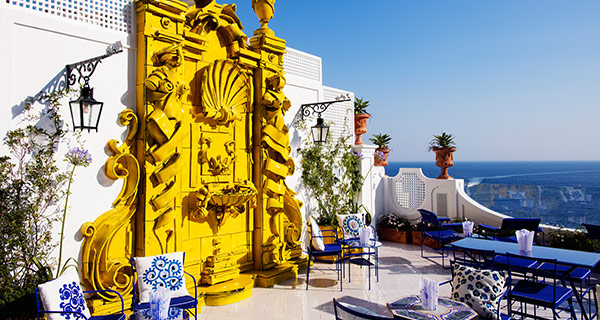
Formerly one of the world’s most scenic car parks, a small terrace just above the Hotel Le Sirenuse has now become a stylish al fresco bar, open to all. The drinks menu is small but pays homage to a golden age of fine beverages, spirits, cocktails and bubbly.

The bar gets it’s name from Franco Sersale, who was an art connoisseur whose impeccable taste did so much to define the signature style of Le Sirenuse. From the pearl-white tiled floor, hand-fired by an ancient Salerno ceramics firm, to the selection of Mediterranean plants,  to designer slender, elegant, deep-blue garden tables and chairs in tubular steel, each new layer both complements and plays off against the others. Completing the design part of the equation are ‘Marie Antoinette’ lamps, intriguing by day and magical by night, Venetian designer fine string curtain made up of antique blue and white glass beads, and Murano tumblers with bold blue stripes. The bar’s logo, a blue sun or starburst with eight mermaid-tail rays, perfectly expresses the playful elegance of Positano’s new open-air salotto.

Franco's BarFranco’s is currently the only bar in Positano where no food is served, with the exception of a few gourmet nibbles (giant green olives, some rather more-ish potato chips). Food just distracts from that view – and the quality of the liquids list.

Located On Via Cristoforo Colombo, just above Le Sirenuse, Franco’s Bar is open daily from 6pm until midnight, weather permitting, from April through to October.

July 16, 2015

Gelato – Summer Treat

Summer in central Tuscany has been warm.  And of course, high temperatures are felt more in the cities.

When Florence becomes too hot to bear, residents and tourists turn to gelato as a survival strategy.

Did you know that Gelato was born in Florence?

Indeed, gelato has Florentine origins. This knowledge will justify gelatoyour copious ice-cream eating in Florence this summer. Believed to have been created by Caterina de’ Medici, the noble lady served gelato to French guests when she married Henry II of France and moved her brigade of Florentine pastry chefs and cooks to Paris in 1533.

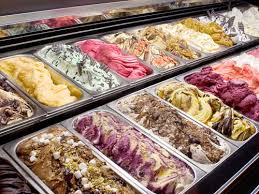
Cold, refreshing and well textured, Florence’s best gelato is not always where you might think. Avoid places with brightly coloured towering piles. Often, the best gelaterias do not even display their delights, preferring to keep them stored at the right temperature in chilled stainless steel containers.

You usually have to pay before you order. Choose between a cup (coppetta) or a cone (cono) and the size that you want. You’ll find that Florentines and long-term expats often go for the smallest possible dimension, preferring quality over quantity.

Even if you opt for the smallest version, you can still order two different varieties. A Florentine classic is buontalenti, a creamy vanilla made from egg yolks, complemented by refreshing fruity options such as lemon, strawberry and almond. Gelato making is not all about the traditional, however. The ice-cream scene is undergoing a revolution with the new generation of gelatai experimenting with unusual tastes, such as Chianti Classico (Edoardo, piazza Duomo), salted caramel (Grom, via dell’Oche) and black sesame (Gelateria Santa Trinita).  BUON APPETITO !

March 3, 2015

Game Viewing in the Maasai Mara of Kenya

IMG_2896 IMG_2899 IMG_3068 IMG_2989 IMG_3060 IMG_3006 IMG_3032 IMG_3001

Kenya offers an unimaginable opportunity to encounter rare and exotic creatures in astounding numbers. From magnificent cats, the world’s greatest herds of elephant, the endangered white and black rhino, thundering herds of zebra and wildebeest stretch across the plain for nearly as far as the eye can see. Other spectacular animals in include grazers such as gazelle, impala, antelope, dik-dik, waterbuck, greater kudu, and of course, the reticulated and Maasai giraffes, the world’s tallest creatures, and the water-loving hippopotamus, the third largest land animal.
Kenya contains the greatest varieties and concentrations of wildlife populations in the world with more than 80 major animal species. The Great Rift Valley, where the Maasai Mara is located, has an ecosystem that is unquestionably the earth’s greatest haven for large mammals. Famed for the dramatic migration of its 1.3 million wildebeest and 200,000 zebras during seasonal crescendos, the movement is more or less a continual journeys following the rains to feed on the fresh phosphorus-rich grass.
A favorite camp is the Fairmont Mara Safari Club, the gracious jewel in the Mara, a one hour flight from Nairobi into a little air strip. Magnificent tents feature lush appointments, four-poster beds and private verandas overlooking hippos bobbing and snorting in the Mara river below. The main lodge is Africa at its most elegant, with stunning artwork, tapestries and dramatic architecture all prominently displayed. A large deck off the lodge follows the curve of the river, creating enchanting seating areas with superb river views and the abundant hippos and crocodiles. And the finishing touch, is the ever present and attentive staff, who are warm and welcoming, treating all clients like honored family guests.