January 10, 2015

Normandy Beaches – 70th Anniversary Visit

mt st michelmere eglisenormandy Cemetaryomaho beachBefore driving into the historic battle theater of Normandy, we began our journey at the southwest coast of Normandy at Mont St-Michel, an important pilgrimage center since AD708.  This UNESCO World Heritage Site is dramatically perched on a 260-foot-high rock island surrounded by ebbing and flowing tides at the westernmost point in Normandy.  It floats like a mirage on the horizon.

Heading north up the coast, our first stop is the celebrated village of Ste-Mere Eglise which served as the center of action for American paratroopers, whose objective in early June of 1944, was to land behind enemy lines in support of the American landing at Utah Beach. During the invasion, in the Utah Beach sector alone, 23,000 men were dropped from planes. The Airbourne Museum, located just off the main square is dedicated to the aerial landings that were essential to the success of D-Day.  One American paratrooper snagged the town’s church steeple and dangled there for two hours. Though many paratroopers were killed in the first hours of the invasion, they played a critical role in the success of the Utah Beach landing. Next stop, Utah Beach, where the infantry landed on the beaches, and the critical supplies followed closely. The Utah Beach Landing Museum (Musee de  Debarquement) nestles in the sand dunes and is built around the remains of a concrete German bunker.  One of the highlights of the museum are the innovative invasion equipment and videos showing details of their creative functionality. Among the displays is a fully restored B-26 bomber with it’s zebra stripes and 11 menacing machine guns – without which the landings would not have been possible. Omaha Beach D-Day Sites include four German casemates (three with guns intact) – hunkered down at the end of a country road.  The guns, 300 yards inland, were arranged in a semicircle to maximize the firing range east and west, and are the only original coastal artillery guns remaining in place in the D-Day region.  The guns could hit targets up to 12 miles away with relatively fine accuracy. Hence, a critical challenge for the eventual success of the Allies.

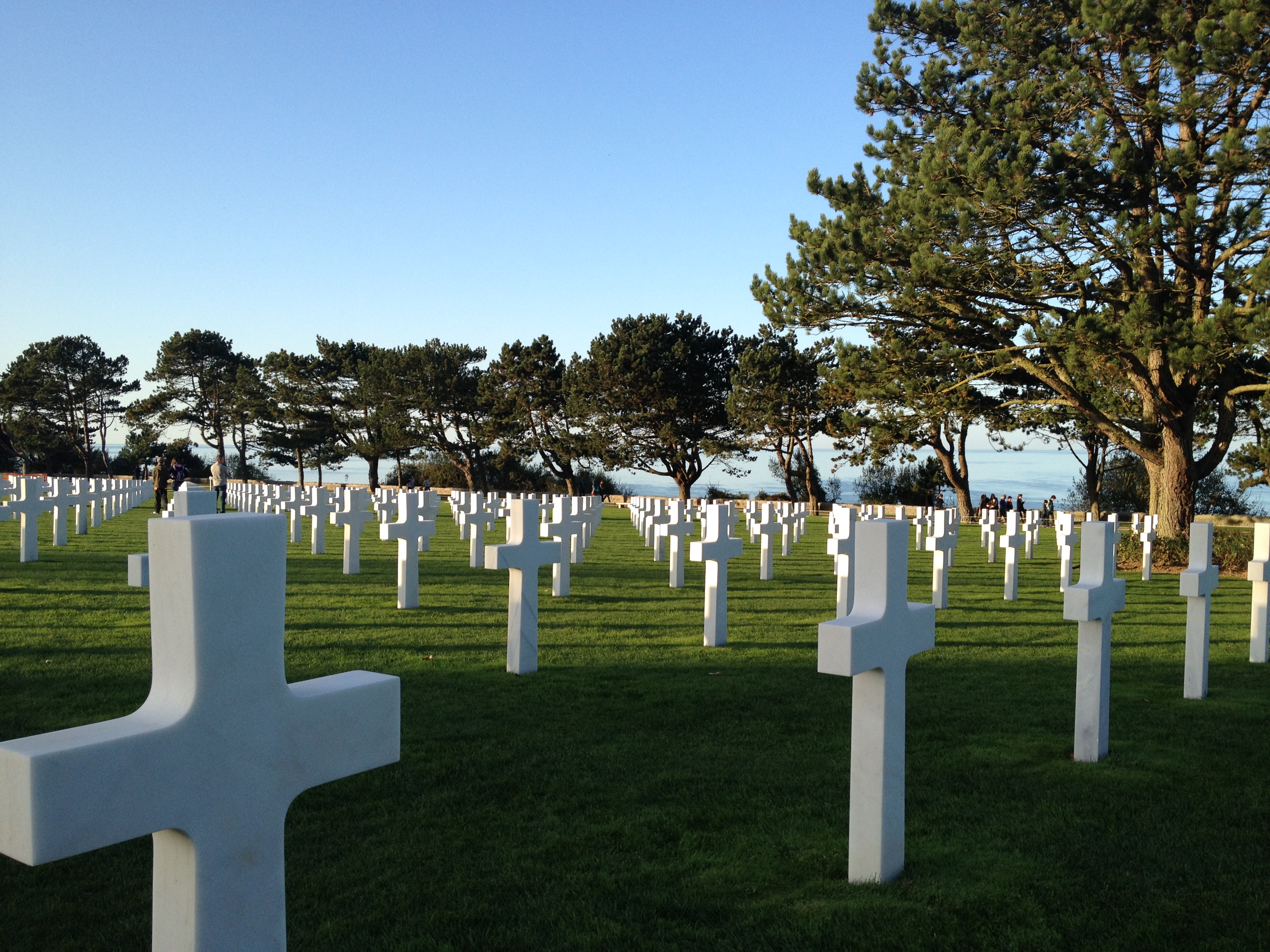
Our last stop along the D-Day Beaches is the poignant Normandy American Cemetery and Memorial, with its 9,387 white marble tombstones on a bluff overlooking Omaha Beach. This expansive 170-acre plot is a dignified tribute to those who gave their lives in a battle for the freedom of Europe. We took an emotional stroll through the endless rows of crosses, and were suddenly drawn to a marker that was the tombstone of a young private from Oregon, bringing our journey close to ‘home’. As we reluctantly leave the Memorial Cemetery, nearing closing time, we passed a gentleman who asked if we enjoyed our visit. It turns out he is the Superintendent of the US Monuments Commission on his third multi-year tour here at the Normandy American Cemetery and Memorial.  Dan Neese is a resident of Coeur d’Alene, Idaho. It was his job to orchestrate the 70th Anniversary of the invasion of Normandy here at the Memorial Cemetery.  Talking with Dan, we learned that over 15,000 guests, including many heads of state, attended the June 6th, 2014  celebration.

From here we moved on to Bayeux, the first French city to be liberated from the Germans.A lovely small city, with a magnificent Cathedral and a museum that houses the famousBayeux Tapestry.  The 11th century tapestry is a 70 yard-long depiction of William the  Conqueror’s Battle of Hastings.

The next day we drove on to Caen to visit the ‘Caen-Normandie Memorial: Center for History and Peace’.  With videos and numerous exhibits on the lead-up to World War II, coverage of the war in both Europe and the Pacific, the Cold War aftermath, and more, it effectively puts the Battle of Normandy into a broader context.  Well worth the visit.

This ended our moving and informative tour of the coast of Normandy, a place which will forever live  in the hearts of freedom loving people worldwide.


September 24, 2014

Sophia Loren Celebrates 80 Years

sophia lorenAn international icon, over 100 films – several award winning – Sophia Loren stands as both Italy’s greatest cinematic export and ‘the embodiment of Italian womanhood’. Born Sofia Scicolone, she was known as Sofia Lazzaro early in her movie career – because her beauty was allegedly said to raise Lazarus from the dead! Renowned as ‘la Loren’ or ‘Donna Sophia’, even the papal secretary of state, Cardinal Tarcisio Bertone, in discussing the Vatican’s opposition to human cloning, once joked that ‘an exception might be made in the case of Sophia Loren.’
She is the recipient of a record six David Di Donatello awards for Best Actress, a Grammy, five special Golden Globes, an Academy Award in 1962 and an Honorary Academy Award in ’91, and Cecil B. DeMille Lifetime Achievement Award, in 1995. As one director said, ‘Sophia is perhaps the only movie star who has never forgotten where she came from.’ Wonderfully human, devoid of glamour and downtrodden in de Sica’s classic wartime tearjerker La Ciociara (Two Women), she was the first Oscar-winning actress for a foreign language film.
Off-screen, too, her Neapolitan roots and warmth show through in her endless embrace of la dolce vita and Italian food. As she once quipped, ‘Everything you see I owe to spaghetti.’ Today she may keep her famous curves in check with pasta portion control – but still attributes her secret for ageless beauty to ‘a love of life, spaghetti, and the odd bath in virgin olive oil.’
Though Sophia Loren turned 80 this month, astonishingly, nothing much has changed. In the fickle world of showbiz, she maintained her one and only 50-plus-year marriage. She works when she wants to; she dotes on her children and grandchildren; she appears regally at red carpet events. Looking every inch the naturally glamorous movie queen – from still enviable hourglass figure to heels – she eclipses so-called stars half her age. She is the ultimate role model not just for older women, but perhaps Everywoman.   Buon Compleanno, Sophia !
September 12, 2014

Volterra – Historic Tuscan Hilltown

Volterra is somewhat like a womb of history. It has nurtured the original Etruscan settlement as far back as the 8th century BC and later it was occupied by the Florentines, the Medici family and then ruled by the Duchy of Tuscany. Evidence of all is to be found within the walls of Volterra. There are numerous museums, galleries and ancient ruins. At the Teatro Romano, there are ancient Roman baths on a deep slope with an arena and columns. It is an incredible excavation in its dimensions, leaving one with a sense of awe at the view of life in Roman times. The Archaeological Park E. Fiumi, an Etruscan site, is still being explored and the Etruscan urns, pots and interesting artifacts line the walls of the museum.
Volterra has beenvolterra_lead mining alabaster since at least the 7th century BC. Its hardness is rated at 2 and 3 on the Mohs scale, alabaster being hydrated calcium sulphate. Alabaster has been used both practically by the Etruscans for their cinerary urns and artistically for alabaster ornaments, lamps, vases, bowls and podiums which are still being made.
Right at the top of the city looms a massive fort, Fortezza Medicea, making this ‘flying city’ seem even higher than it is. Winding roads and a new landscape at every turn, a sense of wonder and anticipation heightens the senses as one approaches Volterra. At night the city lights, seen from the air, make it look like a massive ship sailing on a sea, a dark sea of hills below. There is only one way in and one way out for a vehicle entering the city. It is enclosed within a wall with stone arches as gates, the roads are narrow and the history glows in this timeless place.
Today’s Volterra has wonderful shopping: alabaster, olive wood, paintings and leather spill out from shop entrances into the ancient streets which are lined with fascinating doorways and shuttered windows, and an aroma that can only be found in Italy. Restaurants both formal and informal call from the main streets, but they can also be found tucked away in extraordinary places, by following the delicious waft of herbs and spices. The menus are diverse, but in all you will be offered Tuscan cuisine; a must-try is wild boar cooked with olives and served with black fava beans. Because of its relative closeness to Pisa, fresh fish is also part of the local cuisine.
The city can captivate the tourist for days and if, at any time, one feels the need to escape the walls, then a few miles drive to San Gimignano, Siena or Cecina on the coast provides more historical delight, more beautiful views, vineyards and horizons with silhouetted cypress trees, so typical of Tuscan landscapes.

See more at: http://www.italymagazine.com/featured-story/discovering-volterra#sthash.BEpCSoPE.dpuf

September 8, 2014

Burano – a highlight of the Venetian Lagoon

buranoboatsVenice is a must-visit place for any traveller within its proximity, but keep in mind there are other islands to visit via water bus, like the little island of Burano – the ‘jewel’ in the Venetian crown. From Fondamenta Nuove on  the north side of Venice, the vaporetto takes just 40 minutes to reach the island of Burano. As your boat draws near the island, the multi-coloured terraced homes welcome you. The colours are not just beautiful in the distinct light of the region, but they are practical too. Each one marks the territorial boundary of a property and residents can see their homes from quite a distance, useful for fishermen returning with their catch in the misty morning

Get there on an early boat and you are almost certain to see the ladies of the island sweeping and wiping down their immaculate house fronts. Little brooms and polishing equipment ‘decorate’ many a façade along with ‘buntings’ of white linen which are draped neatly across homes and the little squares linking the narrow passages. The fogher or hooded fireplace gives interest to the outer shape of many of the walls, whose typical Venetian windows are ‘framed’ with a white band.

Archeological evidence has shown that early settlers have inhabited Burano since before the Roman colonization. They  were fishermen, salt gatherers and farmers, all well versed in navigation. Burano’s naturally sheltered position and its detachment from the mainland meant these original lagoon dwellers were protected from invaders and plagues of malaria which were normal in the other islands.

Inhabitants over the centuries raised the ground, dug canals and built bridges to transform a swamp into a hospitable place.The island is approximately seven kilometres from Venice and has always been closely connected to it by its shared past in good and bad times. It was occupied by French and then Austrian troops and contributed its own heroes to the ill-fated 1848 revolution led by Daniele Manin. In 1866, it joined the kingdom of Italy together with the whole of Veneto and became a township of the Municipality of Venice in 1923. It has long been associated with lace, first produced by nuns in the 15th century, and then taken up by fishermen’s wives.

Visit the museum and admire the intricate work of these nimble fingered lace-makers or you can browse the little stalls and small shops along the canal paths into the main square, Piazza B. Galuppi, dedicated to a famous Italian musician born in Burano named Baldassare Galuppi (1706-1785). Tapestries, jewellery, linen and other quality items are on display, but there is no ‘hard sell’ and it is so relaxing to sit with a caffé latte in the one bustling thoroughfare that Burano possesses.  Seafood is another good reason to visit Burano, as there are many excellent restaurants serving typical local dishes mostly centered around the main piazza.


See more at: http://www.italymagazine.com/featured-story/jewel-venetian-lagoon-burano

September 4, 2014

View Siena’s Duomo Mosaic Floor

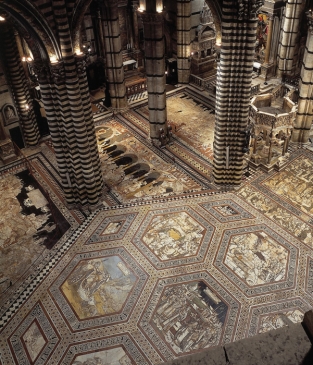
duomo-floorThe extraordinary inlaid marble mosaic floor of Siena’s Cathedral was unveiled on August 18.  Normally covered by carpets for protection, the floor that Giorgio Vasari called “the most beautiful, grand and magnificent” will reveal its marble intarsia works of art that took centuries to complete, beginning in the 14th century and ending in the 16th, with about 40 artists working on it. The floor consists of 56 panels of different sizes, representing sibyls, scenes from the Old Testament, allegories and virtues.

Visitors will also be able to admire the floor from high above by accessing the Porta del Cielo (Gateway to Heaven) at the very summit of the church (reservation required).

The floor will remain uncovered until October 27.

– See more at: http://www.italymagazine.com/news/sienas-duomo-unveils-its-mosaic-floor#sthash.XliUfUYJ.dpuf

August 29, 2014

Chicago “My Kind of Town”

Chicago RiverGrant ParkBuckingham FountainCrown FountainFerris Wheel“Chicago Chicago…my kind of town”….words from Frank Sinatra’s famous song ring true.

We recently spent 48 hours in this world class city with stunning architecture, an abundance of renowned museums, grand hotels, miles of gorgeous beaches and lakefront paths for recreation, champion sports facilities such as Soldiers Field and Wrigley Field, internationally acclaiming symphony, over 200 theaters and endless options for quality dining and clubbing.

The third-largest city in the U.S., is many things at once – a blue-collar town that’s full of culture and gracious living, a classic Midwestern city with international importance, and a multitude of vibrant ethnic neighborhoods.

There are many excellent, city center hotels here.  We stayed at The Swissotel on the Chicago river, just a few blocks from Lake Michigan. Parking was very convenient, though expensive. Our corner room with over 65 feet of glass overlooking the river, the impressive skyline, the Navy Pier and lake was spectacular !

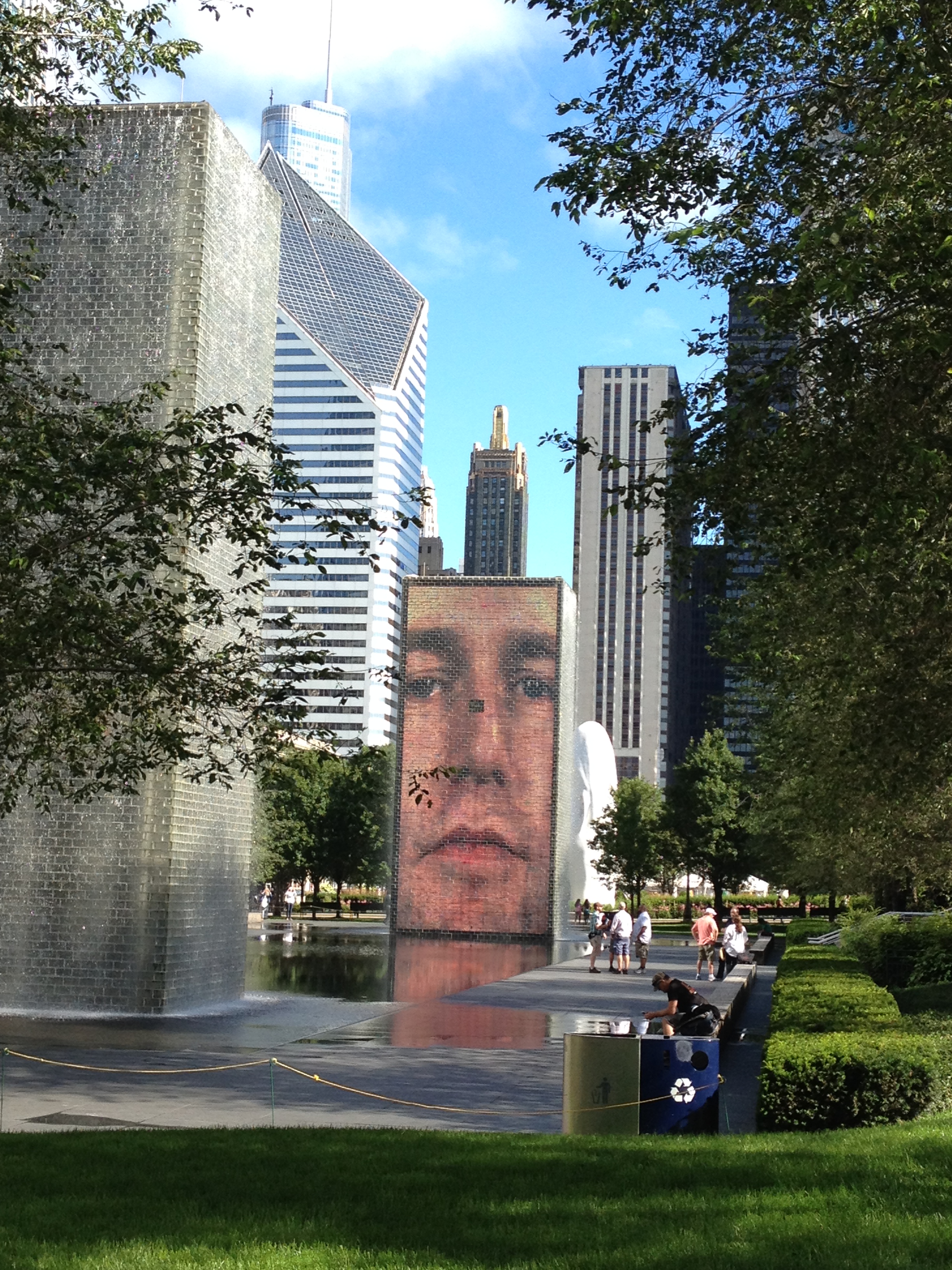
We started our independent walking tour at Millenium Park which was celebrating it’s 10th anniversary this summer. It is highly acclaimed as one of the most successful urban parks in the U.S. This 25 acre park is at the north end of Grant Park and is state-of-the-art, with a high-tech music pavilion designed by renowned architect Frank Gehrey, that hosts regular summer concerts and festivals. Gardens and grassy terraces and the Park Grill make for a large outdoor patio in the summer. The dual interactive Crown Fountain is one of the largest sculptures in the world and the water feature was being enjoyed by many on this hot day. Another sculptor is the 110-ton elliptical ‘Cloud Gate’ (referred to as ‘the bean’) by sculptor Anish Kapoor, which reflects people, buildings, the gardens and sky in its mirrorlike surface.   A serpentine pedestrian bridge links Millenium Park to The Art Institute of Chicago, where we enjoyed lunch at the Terzo Piano restaurant, unfortunately time did not allow us visit the galleries.

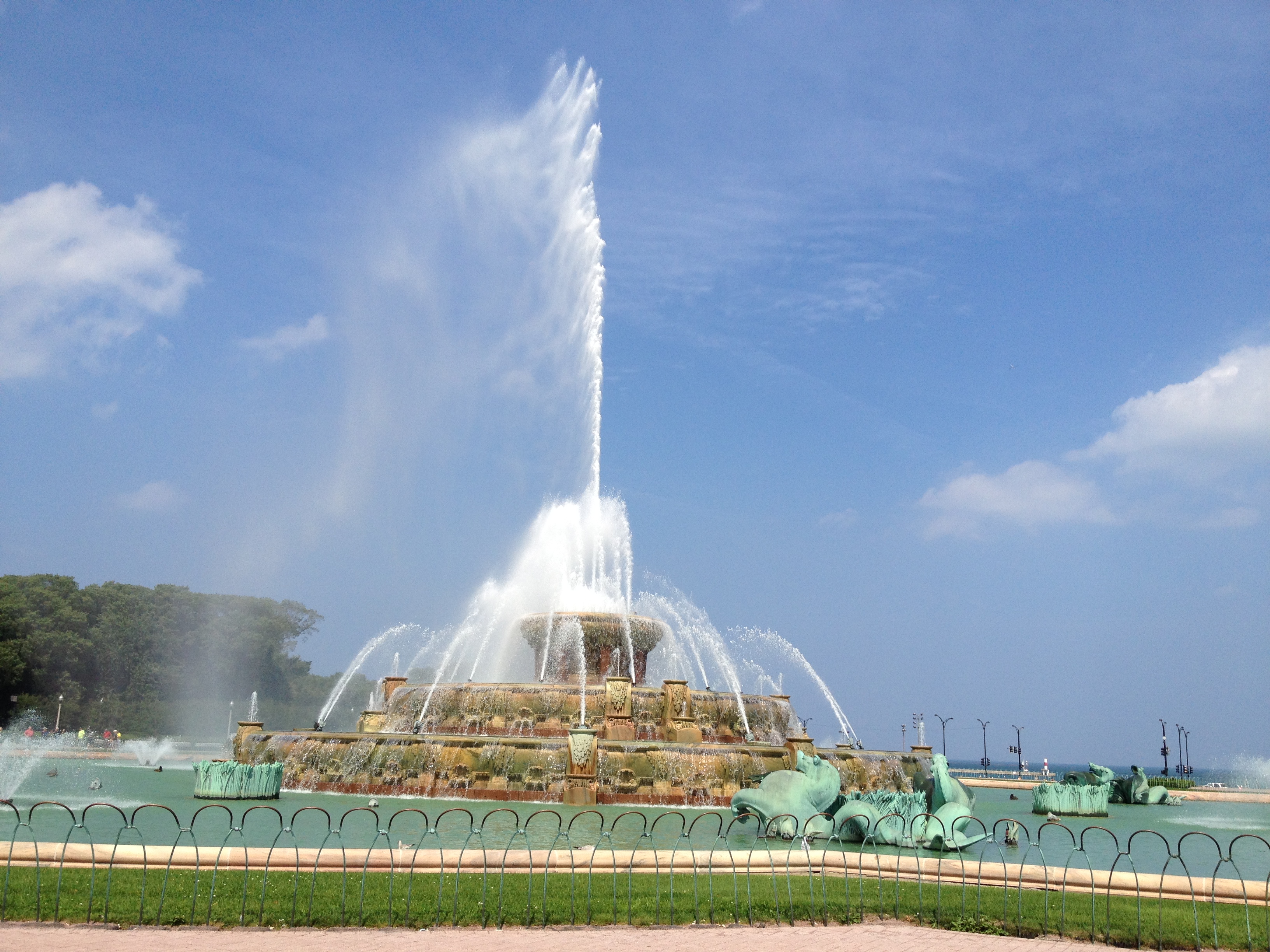
We moved on to Grant Park which runs along the Lake Michigan shoreline and bordered by N. Michigan Avenue on the other side. The landmark Buckingham Fountain in the center of the park, was dedicated in 1927 and is one of the largest fountains in the world. It has regular water shows and evening color-light shows and for obvious reasons is closed in the winter months. It is spectacular !

Our route continued along the Chicago harbor tree-lined pedestrian and bicycle friendly paths down to the Field Museum, the Shedd Aquarium, largest in the world, on to the Adler Planetarium and Astronomy Museum….and a view to the Chicago Bears Soldier Field.  We came up the other side of Grant Park that is bordered by Michigan Ave and were in awe of the cleanliness, beautiful flower beds and massive floral-filled urns, magnificent statues and inviting benches all along and throughout this glorious park.

After crossing the Chicago river, Michigan Avenue turns into the “Magnificent Mile” – Chicago’s largest shopping district, occupied by mid-range to high-end retail stores, restaurants, museums and hotels. Several of the tallest buildings in the United States, such as the John Hancock Center and the Trump Tower, as well as landmark buildings like the Wrigley Building, the Tribune Tower, and the Chicago Water Tower. No time for shopping, but we enjoyed a cocktail in the Signature lounge of the Hancock buildiing on the 94th floor and enjoyed incredible views of the city and beyond !

After a stroll along the Chicago riverwalk, bordered by hotels, city residential space, parks, and restaurants, we boarded a boat for a Chicago Architects Foundation docent guided tour focused on the architectural highlights of Chicago. Chicago rose from the ashes of the Great Fire of 1871 to become the home of the skyscraper and birthplace of modern American architecture. The tour was fascinating and enlightening – not to be missed. Twenty-three bridges cross the Chicago river within the city and every one of them open for taller river boats. The Willis Tower, formerly called the Sears Tower, is still the tallest building in the world if you are talking about occupied space rather than antenna towers.

Navy Pier encompasses 50 acres of parks and gardens, shops, restaurants, an IMAX theater, a carousel and the giant Ferris Wheel, to mention a few things.  From here you can also take boat tours offering views of the city skyline.

If time allows, a few mile north is the famous Lincoln Park, complete with a zoo and a few miles to the south is the prestigious campus of University of Chicago in the Hyde Park neighborhood.  I highly recommend a visit to this vibrant and culturally rich midwestern city !