August 19, 2013

Travel+Leisure Magazine A-List 2013

A-List_Logo[10][4][1][2]Last week Travel+Leisure magazine announced their annual A-List of Top Travel Agents in the world for 2013. I am honored to be included in that list for the second year in a row. My recognition is for my destination expertise in Italy. It gives me great pleasure to assure my clients a memorable travel experience, always returning home as better citizens of the world because of their immersion in another culture.
Though I have been traveling to Italy regularly for over 25 years, I never tire of the remarkable history, art, architecture, scenery, people, cuisine and culture of Bella Italia!

Be sure to pick up a copy of the October issue of Travel+Leisure magazine or visit www.travelandleisure.com/top-travel-agents-a-list now for the complete list of A-List Travel Agents.

August 16, 2013

Gelato Anyone?

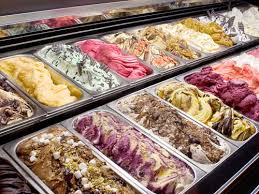
gelatoThe “modern” history of gelato begins in the Renaissance with alchemist Cosimo Ruggieri, who is credited with creating the first gelato flavor at the court of the Medici family in Florence, the fior di latte. Gelato and sorbets were food for the rich because ice and salt were expensive and, therefore, only served in private residences.
The Sicilian Francesco Procopio Cutò made gelato available to all when he opened Café Le Procope in Paris in 1686 and started selling it to the public. In the 19th century, the Neapolitan doctor Filippo Baldini wrote a treatise where he stated that gelato and sorbets are good both for the body and mind. Welcome news for many of us…surely it’s still true!

The origins of gelato go back 12,000 years when, in Mesopotamia, slave runners traveled up to 100 kilometers to collect ice and snow used to cool drinks served during royal banquets and religious ceremonies. During the 11th century, the Arabs developed shrb, “sugar syrup”, a base for making fruit sorbets, medical herbs, spices and flowers. Shrb was the predecessor of sorbet, which became very popular in Sicily when it was under Arab rule; the Arabs grew in fact as many as 400 different types of flowers to flavor their sorbets.

Well, thanks to the early culinary artists….”I scream, you scream, we all scream for gelato !” ..and our demand is granted !

August 7, 2013

Un poco Italian

photo5I always recommend that my Italy bound clients learn a few basic Italian words and phrases. Although English is spoken in most tourist parts of Italy, knowing a little bit of Italian will definitely improve your experience. Italian’s genuinely appreciate the visitor who ‘makes the effort’, even if it is just your greeting “Buongiorno” or “Arrivederci”.

Dianne Hales, author of La Bella Lingua: My Love Affair with Italian, the World’s Most Enchanting Language says, “I’ve spent more than 25 years learning as much Italian as I possibly can, but the question I’m often asked is ‘What do I need just to get by in Italy?'”
Here Dianne shares her recommendations for the least Italian you should know:
•Greetings. Know how to say “buongiorno” (bwohn-JOR-noh) for “Good morning” or “Good Day”; “buona sera” (BWOH-nah-SAY-ra) for “Good evening”; and “arrivederci” (ah-ree-vay-DEHR-chee) for goodbye (obligatory when you leave a shop or restaurant).
•Disclosure. Say up front, “Non parlo italiano” (nohn PAR-loh ee-tah-leeAH-non) for “I don’t speak Italian.” A good follow-up question: Parla inglese? (PAR-lah een-GLAY-zay) Do you speak English?
•Courtesy. Please, thank you, and you’re welcome are the most important phrases in any language. The Italian phrases are “per favore” (pehr fah-VOH-ray); grazie (GRAHT-zee-ay) and prego (PRAY-goh).
•Personal preferences. Wherever you go, someone will ask, “Va bene?” (VAH BAY-ne): “Is it going well? Is everything okay?” If it is, you can reply “Si, bene!” (see BEHN-nay) for yes, all is well. “Mi piace” (mee pee-AH-chay) means “I like”; non mi piace, “I don’t like it.”
•Prices. Bottom line, you’re going to be buying food, tickets, souvenirs and other irresistible things. Before you do, you’ll want to know, “Quanto costa?” (KWAHN-toh KOH-sta): How much does it cost?

Buon viaggio! Have a good trip.

July 12, 2013

Dusting down Piazza Duomo in Florence

FLR DuomoFlorence’s Piazza del Duomo is getting a thorough cleaning in preparation for the November 2015 National Conference of the Italian Church being held in Florence. The event will bring 3500 Cardinals and Bishops and possibly warrant a visit by Pope Francis. All of the marble facades of the buildings and monuments occupying the square will be cleaned and restored, which is over 40,000 square meters of surface. Currently the project is focused on the Duomo, inside and out, followed by the restoration of the Baptisty and the Palazzi dei Canonici.

The Opera di Santa Maria del Fiore, the non-profit organization that protects and promotes Florence’s cathedral, has undertaken this significant project.

In a effort to make families feel more welcome to visit the museum in Piazza Duomo and the monumnets, a new combined ticket, costing 10 Euro, has been introduced and admission is free for children under the age of 15. This may reduce the queues a bit as well.

July 3, 2013

Parlez-vous polite?

effiel towerThe majority of my clients are heading to Italy this summer and and fall, however quite a few have Paris on their travel agendas. They are going to experience a warmer welcome from the Parisians due to a new city sponsored project called “Do You Speak Touriste?”
As the saying goes, Paris would be great, if it weren’t for the French. Now, in an effort to improve tourism in a down economy, the city is distributing pamphlets to local businesses teaching them how to not be so famously rude to visitors.
Aimed at improving relations between the 80,000 visitors a day and front line workers like taxi drivers, servers, hoteliers, museum staffers, and merchants, “Do You Speak Touriste?” provides colorful cheat sheets aimed at helping Parisians shed their snooty image. The city’s tourism board is passing out the six-page guide directly to service personnel, and also has an accompanying website. “I think they know it’s desperate,” Elaine Sciolino, a New York Times writer in Paris told TODAY, “I mean the economy is really hurting, and unemployment is at ten percent. Foreign investment is way down, so you’ve got to keep tourism up.”
For instance, to understand Americans, the guide says, locals should know they demand WiFi, enjoy high-end hotels, and prefer to have dinner at 6 p.m. Meanwhile, Germans want to converse in German. Spanish like amusement parks. Feeling uncertain about navigating an unknown city, the Japanese need to be reassured. And the guide describes the Chinese as “fervent shoppers,” gently reminding readers that “a simple smile and hello in their language will fully satisfy them.”

The pamphlet provides tips for 11 different nationalities in total. But not everyone feels they need the new handbook. Chef Francois Pasteau of L’Epi Dupin has insisted his staff speak English, among other languages, for the last 18 years. “Why you have to be rude with customers??” Pasteau told TODAY. “No! You have to be nice, with everybody!” With tourists lining up to dine at his bistro, the attitude seems to be working.

For a video newscast to hear more, click here to watch.

June 11, 2013

Traveling by Train in Italy

photo11Once again, Italy is the top destination that my clients are traveling to this spring, summer and fall. And most of them are traveling by train at least once during their trip. So I thought this was perfect timing for a refresher on Italy’s train system.

Italy largest public rail system consists primarily of three types of train – the regional or local slower trains, the intercity faster trains with fewer stops, and the Eurostar and Frecce fast trains. Seat reservations on Eurostar Italia and Le Frecce trains are mandatory. Eurostar Italia trains have now mainly been replaced by the Frecce series that serve major cities and you’ll see them designated on the Trenitalia web site as Frecciarossa, Freeiargento, and Frecciabianca, however on the departure board at the station they may still be designated by ES (Eurostar). Reservations are generally offered on Intercity trains and sometimes are mandatory and not needed or offered on the regional routes.

First and second class service is available, though some regional have only second class. If you wish to guarantee yourself a seat on a regional train, buy first class if offered. First class coaches offer slightly better seats and are generally less crowded. If you find that your train is crowded and you can’t find a seat in second class, you may try to find a conductor and ask if your ticket can be upgraded to first class.

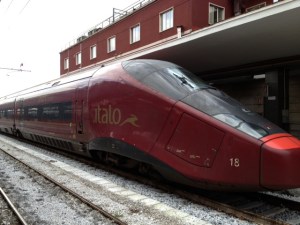
Italo, a private train company, which began service in June of 2012, runs fast trains on 8 routes currently. Italo offers three classes of service. I posted my postive experience on Italo a few months ago.

Now for some vocabulary. In Italian, the tracks are called binari (track numbers are listed under bin on the departure board). In smaller stations where the trains go through the station you’ll have to go underground using the sottopassagio or underpassage to get to a track that isn’t Binario uno or track number one. Larger stations like Milano Centrale, where the trains pull into the station rather than passing through, you’ll see the trains head-on, with signs on each track indicating the next expected train and its departure time.
If you have a regional train ticket (or any ticket without a specific date, time, and seat assignment), just before you board your train, find the green and white box (or in some cases the old-style yellow machines) and insert the end of your ticket. This prints the time and date of the first use of your ticket, and makes it valid for the journey. There are stiff fines for not validating a ticket. Validation applies mainly to regional train tickets and any ticket that does not have a specific date, time, and seat number on it.

Once you find your train, just board it. You will probably have to show your biglietto or ticket to a conductor once during your journey–so keep it where you can get to it. Usually there are racks above the seats for luggage. Sometimes there are dedicated shelves near the ends of each coach for your larger baggage. Note that you will not find porters in the station or waiting by the track to help you with your luggage, you will need to get your luggage onto the train yourself.

A simple buon giorno will do nicely to greet your seat mate. If you want to know if a seat (posto) is vacant, simply say Occupato? or E libero?.

One last tip, since there may be multiple stations in your destination city, be sure you get off at the right one. Buon Viaggio !