 Once again, Italy is the top destination that my clients are traveling to this spring, summer and fall. And most of them are traveling by train at least once during their trip. So I thought this was perfect timing for a refresher on Italy’s train system.
Italy largest public rail system consists primarily of three types of train – the regional or local slower trains, the intercity faster trains with fewer stops, and the Eurostar and Frecce fast trains. Seat reservations on Eurostar Italia and Le Frecce trains are mandatory. Eurostar Italia trains have now mainly been replaced by the Frecce series that serve major cities and you’ll see them designated on the Trenitalia web site as Frecciarossa, Freeiargento, and Frecciabianca, however on the departure board at the station they may still be designated by ES (Eurostar). Reservations are generally offered on Intercity trains and sometimes are mandatory and not needed or offered on the regional routes.
First and second class service is available, though some regional have only second class. If you wish to guarantee yourself a seat on a regional train, buy first class if offered. First class coaches offer slightly better seats and are generally less crowded. If you find that your train is crowded and you can’t find a seat in second class, you may try to find a conductor and ask if your ticket can be upgraded to first class.
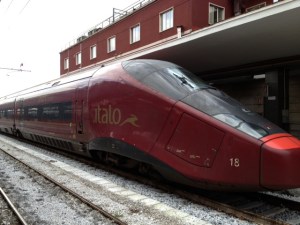
Italo, a private train company, which began service in June of 2012, runs fast trains on 8 routes currently. Italo offers three classes of service. I posted my postive experience on Italo a few months ago.
Now for some vocabulary. In Italian, the tracks are called binari (track numbers are listed under bin on the departure board). In smaller stations where the trains go through the station you’ll have to go underground using the sottopassagio or underpassage to get to a track that isn’t Binario uno or track number one. Larger stations like Milano Centrale, where the trains pull into the station rather than passing through, you’ll see the trains head-on, with signs on each track indicating the next expected train and its departure time.
If you have a regional train ticket (or any ticket without a specific date, time, and seat assignment), just before you board your train, find the green and white box (or in some cases the old-style yellow machines) and insert the end of your ticket. This prints the time and date of the first use of your ticket, and makes it valid for the journey. There are stiff fines for not validating a ticket. Validation applies mainly to regional train tickets and any ticket that does not have a specific date, time, and seat number on it.
Once you find your train, just board it. You will probably have to show your biglietto or ticket to a conductor once during your journey–so keep it where you can get to it. Usually there are racks above the seats for luggage. Sometimes there are dedicated shelves near the ends of each coach for your larger baggage. Note that you will not find porters in the station or waiting by the track to help you with your luggage, you will need to get your luggage onto the train yourself.
A simple buon giorno will do nicely to greet your seat mate. If you want to know if a seat (posto) is vacant, simply say Occupato? or E libero?.
One last tip, since there may be multiple stations in your destination city, be sure you get off at the right one. Buon Viaggio !


 Florence’s Piazza del Duomo is getting a thorough cleaning in preparation for the November 2015 National Conference of the Italian Church being held in Florence. The event will bring 3500 Cardinals and Bishops and possibly warrant a visit by Pope Francis. All of the marble facades of the buildings and monuments occupying the square will be cleaned and restored, which is over 40,000 square meters of surface. Currently the project is focused on the Duomo, inside and out, followed by the restoration of the Baptisty and the Palazzi dei Canonici.
 The majority of my clients are heading to Italy this summer and and fall, however quite a few have Paris on their travel agendas. They are going to experience a warmer welcome from the Parisians due to a new city sponsored project called “Do You Speak Touriste?”








 Journeys Viaggio